admin
admin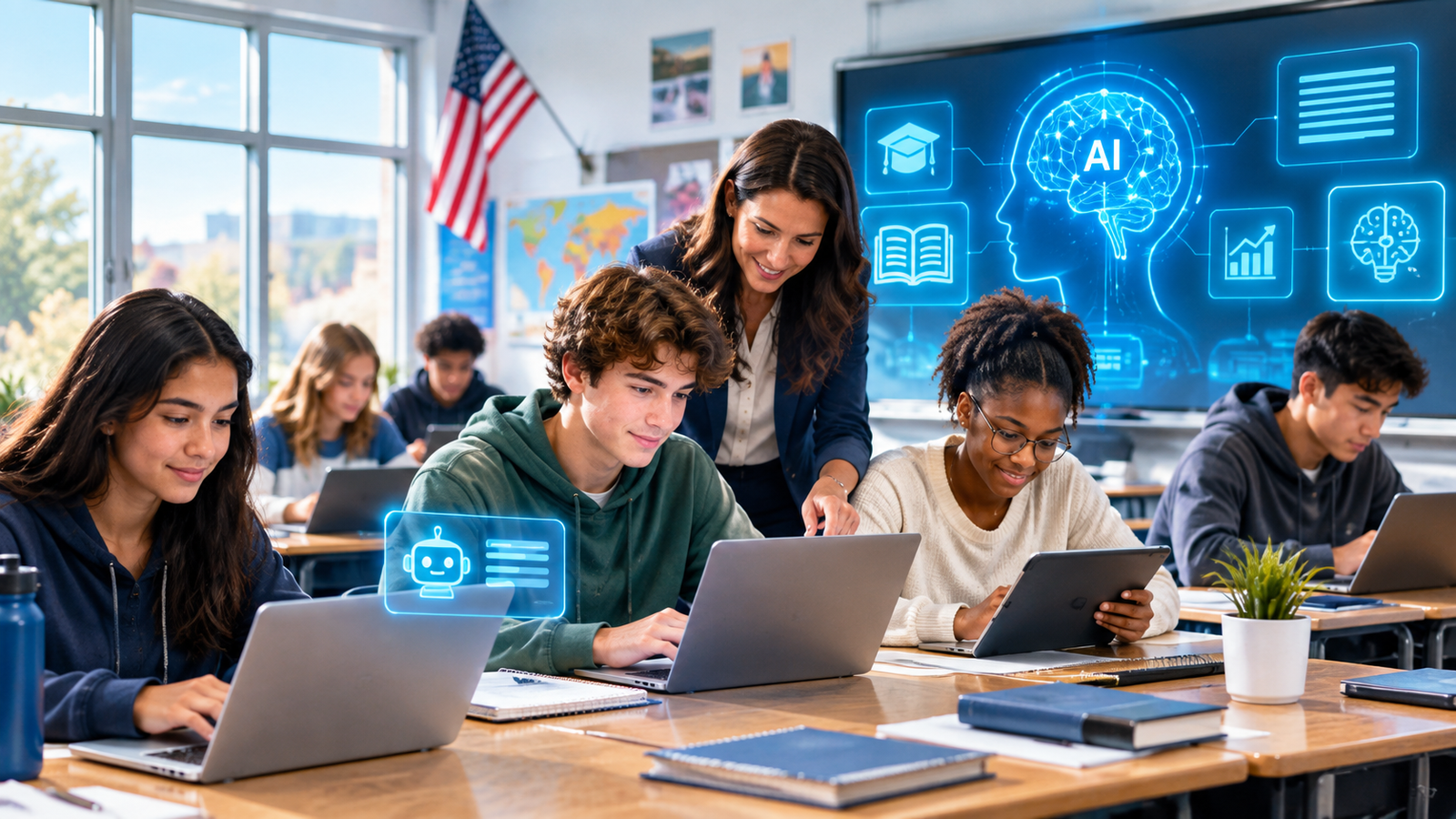
Artificial intelligence is rapidly becoming part of everyday education in the United States. From high schools and colleges to universities and online learning platforms, AI tools are changing how students study, how teachers prepare lessons, and how schools think about technology.
In 2026, the conversation is no longer simply about whether students are using AI. The bigger question is how schools can use artificial intelligence while protecting learning, privacy, critical thinking, and academic integrity.
AI Use Among U.S. Students Is Growing
AI has become a common tool for many American students. Stanford’s 2026 AI Index reports that four out of five U.S. high school and college students use AI for schoolwork. Students commonly use generative AI for research, essay editing, and brainstorming.
Pew Research Center also found that just over half of U.S. teens have used chatbots to get help with schoolwork. Among teens who use chatbots for school, common activities include researching topics, solving math problems, and editing written work.
This rapid adoption means AI is becoming part of the normal digital environment in which many American students learn.
How Students Are Using AI for School
Students are using artificial intelligence in several ways, including:
- Researching school topics
- Brainstorming ideas
- Understanding difficult concepts
- Solving practice problems
- Editing essays
- Creating study notes
- Preparing for exams
- Getting explanations of unfamiliar subjects
Used appropriately, AI can provide students with another source of explanations and practice. However, students still need to check information and understand the material themselves.
Schools Are Creating New AI Policies
The growth of AI has also created a need for clearer school policies.
Stanford’s 2026 AI Index says only about half of middle and high schools have AI policies, while just 6% of teachers surveyed said those policies were clear.
Across the United States, policymakers and school systems are considering rules covering student AI use, privacy, teacher oversight, academic integrity, and the use of AI in important educational decisions.
A 2026 review of state legislation found that 134 AI-in-education bills had been introduced across 31 states, with major themes including student data privacy, classroom boundaries, human oversight, and AI literacy.
Teachers and AI
Artificial intelligence is also changing the work of teachers.
Teachers can use AI-assisted tools for tasks such as lesson planning, creating practice materials, generating ideas, and providing different explanations of a topic.
However, AI does not remove the importance of teachers. Human educators remain responsible for understanding students, providing context, evaluating learning, and making professional judgments.
The U.S. Department of Education’s August 2026 guidance encourages schools to focus on instructional value, evidence, educator judgment, transparency, and student outcomes when choosing education technology.
The Challenge of Academic Integrity
One of the biggest questions surrounding AI in education is academic integrity.
Some students use AI as a learning assistant, while others may use it to generate work they submit as their own. Pew Research Center found that 59% of U.S. teens surveyed believe AI cheating occurs at least somewhat often at their school.
This has pushed schools to rethink traditional assignments and assessment methods.
Instead of focusing only on whether a student used AI, educators are increasingly considering how assignments can demonstrate genuine understanding, research, reasoning, and individual work.
AI and Personalized Learning
Another major possibility is personalized learning.
Students often have different learning speeds and different areas of difficulty. AI-powered educational tools can potentially provide additional explanations, practice questions, and feedback.
For example, a student struggling with algebra could ask an AI tutor to explain a problem step by step. Another student might use the same technology to practice more advanced problems.
The important factor is whether the technology actually improves learning rather than simply increasing screen time.
Student Privacy Is an Important Issue
AI in education also raises questions about student data.
Schools and technology providers may collect information about students when digital platforms are used. This makes privacy, transparency, security, and responsible data handling important considerations.
In 2026, state lawmakers are considering measures related to student data and AI. Some proposals seek to restrict the use of student information for AI training or require additional protections for educational technology.
Parents and students should understand what information an educational AI tool collects and how that information is used.
AI Skills Are Becoming Part of Education
Artificial intelligence is not only affecting current schoolwork. It is also influencing the skills students may need after graduation.
Stanford’s 2026 AI Index reports that AI-related graduate programs continued to grow even as computer science enrollment at U.S. four-year universities declined between 2024 and 2025.
This reflects growing interest in AI-related skills across higher education and the workforce.
Students may increasingly benefit from understanding not only how to operate AI tools but also how to evaluate AI-generated information, protect data, recognize errors, and use technology responsibly.
What Should Students Know About AI?
Students can use AI more effectively when they treat it as a learning tool rather than a replacement for learning.
Good practices include:
- Use AI to understand difficult topics.
- Check important information using reliable sources.
- Follow your school’s AI rules.
- Do your own thinking before asking AI for an answer.
- Avoid sharing private or sensitive information with AI tools.
- Use AI to practice and learn instead of simply copying answers.
- Develop strong writing, research, mathematics, and critical-thinking skills.
What Is the Future of AI in American Education?
The future of AI in U.S. education is still developing.
The U.S. Department of Education has described AI integration as a process that can move from initial concern and skill-loss risks toward responsible adoption and eventually broader changes in how education is designed.
At the same time, recent U.S. education reporting shows that AI is only one of several major trends shaping schools in 2026, alongside student engagement and teacher support.
The future will likely involve a combination of technology and human instruction rather than technology operating alone.
Final Thoughts
AI is changing education in the United States in 2026, and students are already using it at a significant scale.
The technology can help students research, practice, brainstorm, and understand difficult subjects. It can also create challenges involving academic integrity, privacy, policy, and the development of independent skills.
For American schools, the central challenge is finding practical ways to use AI while keeping learning and human judgment at the center.
As artificial intelligence continues to develop, AI literacy may become an increasingly important part of education in the USA.